AI Tokens Explained is one of the most important concepts to understand if you want to use modern Artificial Intelligence tools effectively. Whether you’re creating content, generating code, analyzing data, or building AI-powered applications, knowing how AI tokens work can help you write better prompts, reduce API costs, and improve response quality.
Artificial Intelligence (AI) has transformed how people write content, generate code, analyze data, and automate business tasks. Whether you’re using ChatGPT, Claude, Gemini, DeepSeek, or another large language model (LLM), one technical term appears everywhere: tokens.
Many beginners assume AI counts words or characters. In reality, modern AI models process tokens, not complete words. Understanding tokens is essential because they determine how much information an AI model can read, remember, and generate. They also affect API pricing, response quality, and context limitations.
If you’ve ever wondered why an AI forgets earlier parts of a conversation or why API costs vary, the answer usually comes down to tokens.
In this AI Tokens Explained guide, you’ll learn everything you need to know about input tokens, output tokens, and context tokens, how they work, why they matter, and how to use them efficiently in today’s AI tools.
What Are AI Tokens?
An AI token is the smallest piece of text an AI language model processes.
A token is not always a complete word. It may be:
- A complete word
- Part of a long word
- A punctuation mark
- A number
- A space
- A special symbol
For example:
| Text | Approximate Tokens |
|---|---|
| Hello | 1 |
| Artificial Intelligence | 2–3 |
| ChatGPT is amazing! | 5–7 |
| $199.99 | 4–6 |
Different AI models use different tokenization methods, so token counts vary slightly.
Why Do AI Models Use Tokens Instead of Words?
Computers don’t naturally understand human language.
Before processing text, AI converts everything into tokens that can be represented as numbers. These numerical representations allow neural networks to analyze relationships between words and generate meaningful responses.
Using tokens instead of words helps AI:
- Understand multiple languages
- Handle punctuation correctly
- Process emojis and symbols
- Work with programming languages
- Predict the next token efficiently
This is why tokens form the foundation of every modern Large Language Model.
How Tokenization Works
Tokenization is the process of breaking text into smaller units.
Consider this sentence:
AI is changing the world rapidly.
It may become tokens like:
- AI
- is
- changing
- the
- world
- rapidly
- .
The AI processes these tokens one by one.
For longer words, tokenization might split them into smaller pieces.
Example:
“internationalization”
might become several smaller tokens instead of one.
This makes vocabulary management much more efficient.
What Are Input Tokens?
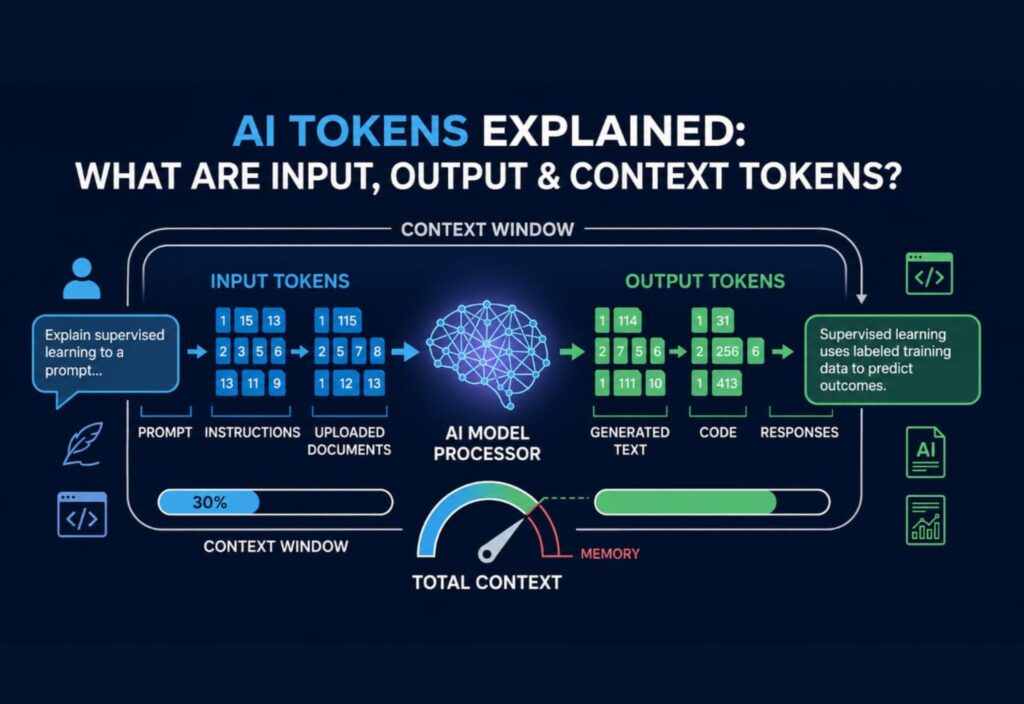
Input tokens are the tokens you send to the AI model.
Everything included in your request counts as input:
- Your prompt
- Instructions
- Previous conversation
- Uploaded text
- Documents
- Code
- System prompts (in many API implementations)
Example
Prompt:
Explain machine learning in simple words.
Every token in that sentence becomes an input token.
The longer your prompt, the more input tokens you use.
Examples of Input Tokens
These all consume input tokens:
- Writing prompts
- Long blog articles
- Research papers
- PDFs
- Source code
- Chat history
- Meeting transcripts
- Product descriptions
If you upload a 20-page document, all of its text contributes to input tokens.
What Are Output Tokens?
Output tokens are the tokens generated by the AI model in its response.
Everything the AI writes counts as output.
For example:
Prompt:
Write five SEO tips.
AI Response:
- Use keyword research.
- Optimize title tags.
- Improve page speed.
- Create quality content.
- Build internal links.
Every word, number, and punctuation mark generated becomes an output token.
Generally:
- Short responses use fewer output tokens.
- Long articles use many output tokens.
- Detailed explanations increase output token usage.
What Are Context Tokens?
Context tokens refer to the total amount of information an AI model can consider at one time.
The context includes:
- Your current prompt
- Previous conversation
- Uploaded documents
- AI instructions
- Generated responses still within the conversation window
Think of context as the AI’s temporary working memory.
When the context window fills up, older information may be removed or summarized, depending on the model.
Understanding the Context Window
Imagine an AI model has a context window of 128,000 tokens.
That limit includes:
- Previous conversation
- Current prompt
- AI response
Example:
Previous conversation = 50,000 tokens
Current prompt = 10,000 tokens
Response = 5,000 tokens
Total used:
65,000 tokens
There is still room before reaching the maximum context limit.
Once the limit is exceeded, the oldest content may no longer be available to the model.
Input vs Output vs Context Tokens
🔹 Input Tokens
- Source: User
- Includes Prompt: ✅ Yes
- Includes AI Response: ❌ No
- Affects Pricing: ✅ Yes
- Limited by Context Window: ✅ Yes
🔹 Output Tokens
- Source: AI Model
- Includes Prompt: ❌ No
- Includes AI Response: ✅ Yes
- Affects Pricing: ✅ Yes
- Limited by Context Window: ✅ Yes
🔹 Context Tokens
- Source: Both User and AI
- Includes Prompt: ✅ Yes
- Includes AI Response: ✅ Yes
- Affects Pricing: ⚠️ Indirectly
- Limited by Context Window: ✅ Yes
Why Tokens Matter
Understanding tokens helps you:
- Reduce API costs
- Write better prompts
- Prevent context overflow
- Improve AI accuracy
- Build scalable AI applications
Businesses using AI at scale often optimize prompts specifically to reduce token usage.
How Tokens Affect AI Pricing
Most AI providers charge based on token usage.
Typically, pricing is divided into:
- Input tokens
- Output tokens
Longer prompts increase input costs.
Longer responses increase output costs.
Developers building AI-powered applications monitor token usage carefully to control expenses.
Example of Token Usage
Suppose you send:
Prompt:
500 tokens
AI generates:
1,000 tokens
Total processed:
1,500 tokens
Billing depends on both input and output tokens.
Why Long Conversations Become Less Accurate
Many users notice that AI sometimes forgets earlier messages.
This usually happens because:
- The conversation exceeds the context window.
- Older tokens are removed.
- Important instructions disappear.
- Context becomes crowded with unnecessary information.
Keeping conversations focused helps maintain better accuracy.
Tips to Reduce Token Usage
1. Write Clear Prompts
Instead of:
Tell me everything about AI.
Use:
Explain supervised learning in 300 words.
Specific prompts reduce unnecessary output.
2. Remove Unnecessary Text
Avoid repeating instructions in every message.
3. Summarize Large Documents
Instead of uploading a 100-page report, summarize key sections first.
4. Limit Response Length
Ask for:
- 300 words
- Bullet points
- Summary
- Table
instead of unlimited responses.
5. Start a New Chat When Needed
Very long conversations consume context.
Starting a new chat often improves response quality.
Common Misconceptions About Tokens
Myth 1: One Word Equals One Token
False.
Long words may contain several tokens.
Myth 2: Spaces Don’t Count
Spaces can influence tokenization.
Myth 3: Only User Messages Count
Incorrect.
AI responses also consume tokens.
Myth 4: Context Is Unlimited
Every AI model has a maximum context window.
Myth 5: Tokens Only Matter for Developers
Even everyday users benefit from understanding tokens because they affect response quality, speed, and pricing on many AI services.
Real-World Examples
Content Writing
A blogger generating a 2,000-word article uses significantly more output tokens than someone requesting a short summary.
Coding
Uploading an entire software project can consume tens of thousands of input tokens, leaving less room for the model’s response.
Customer Support
AI assistants handling long customer conversations need efficient context management to avoid forgetting earlier details.
Research
Researchers often summarize lengthy papers before asking detailed questions, reducing token usage while keeping responses accurate.
Best Practices for Using Tokens Efficiently
- Keep prompts concise and specific.
- Remove repetitive instructions.
- Use summaries for long documents.
- Request only the level of detail you need.
- Monitor token usage when using APIs.
- Break very large tasks into smaller steps.
- Start new conversations when context becomes cluttered.
These practices help improve both performance and cost efficiency.
Frequently Asked Questions (FAQs)
Are tokens the same as words?
No. A token may be a whole word, part of a word, a number, punctuation, or another text fragment.
Why do AI companies charge by tokens?
Because tokens represent the amount of text the model processes and generates, making them a practical measure of computational workload.
Do emojis count as tokens?
Yes. Emojis are tokenized just like text, though the exact token count varies by model.
Can AI remember unlimited conversations?
No. Every model has a fixed context window. Older information may be dropped when the limit is reached.
How can I reduce AI costs?
Use shorter prompts, avoid unnecessary repetition, summarize long documents, and limit response length when appropriate.
Final Thoughts
AI tokens are the building blocks of modern language models. Instead of reading complete words, AI systems process text as tokens, allowing them to understand language, generate responses, and perform complex reasoning tasks.
By understanding the differences between input tokens, output tokens, and context tokens, you can write more effective prompts, manage AI costs, and get better results from tools like ChatGPT and other LLMs. Whether you’re a casual user, content creator, developer, or business owner, learning how tokens work will help you use AI more efficiently and make smarter decisions as AI technology continues to evolve.