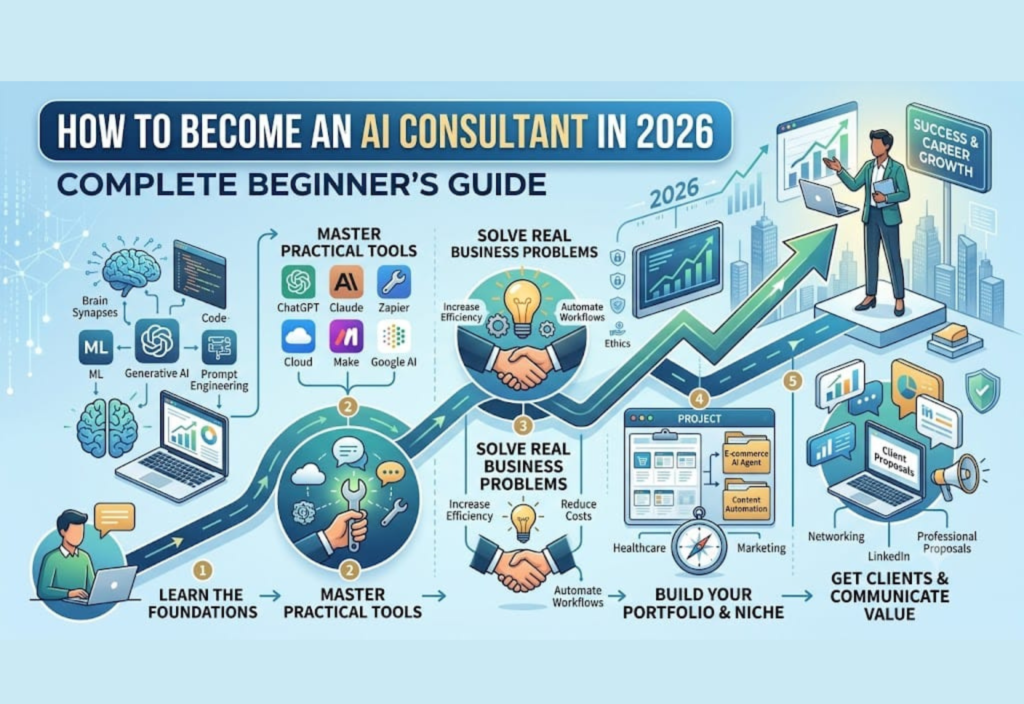
Becoming an AI Consultant is one of the smartest career choices in 2026. As artificial intelligence becomes a core part of modern business, organizations need professionals who can help them understand, implement, and manage AI solutions. From small startups to global enterprises, businesses are investing in AI to automate workflows, improve customer experiences, and increase productivity. However, many companies don’t know where to start. That’s where AI consultants provide real value.
The good news is that you don’t need a PhD in artificial intelligence or years of software engineering experience to become an AI consultant. Instead, you need to understand how AI tools solve business problems, communicate effectively with clients, and recommend practical solutions. With the right skills and experience, you can build a successful freelance career, join a consulting firm, or even launch your own AI consulting business.
In this guide, you’ll learn what an AI consultant does, the skills you need, how to gain experience, and the practical steps to start your AI consulting career in 2026.
What Is an AI Consultant?
An AI consultant helps businesses identify opportunities where artificial intelligence can improve efficiency, reduce costs, and increase revenue. Rather than building complex AI models from scratch, consultants focus on understanding business challenges and recommending the most suitable AI solutions.
Depending on the client, an AI consultant may:
- Analyze business processes
- Recommend AI tools
- Design automation workflows
- Improve customer support systems
- Develop AI adoption strategies
- Train employees to use AI tools
- Measure AI performance and ROI
The role combines technology knowledge with business strategy, making it one of the fastest-growing careers in the AI industry.
Why AI Consultants Are in High Demand
Artificial intelligence is no longer limited to technology companies. Today, businesses across healthcare, finance, education, retail, real estate, manufacturing, and marketing are using AI to improve daily operations.
Many business owners know AI is important, but they often struggle with questions like:
- Which AI tool should we choose?
- How can AI improve our workflow?
- Is AI worth the investment?
- How do we train our team?
- What tasks should be automated first?
An AI consultant answers these questions and helps businesses implement AI successfully. As a result, companies can save time, improve efficiency, and make better business decisions.
Skills Every AI Consultant Should Learn
A successful AI consultant needs both technical and business skills. Fortunately, many of these can be learned through online courses, practical projects, and hands-on experience.
1. AI Fundamentals
Understand the basics of:
- Artificial Intelligence
- Machine Learning
- Generative AI
- Large Language Models (LLMs)
- AI Agents
- Prompt Engineering
You don’t need to become a researcher, but you should understand how these technologies work and where they are most useful.
2. Business Problem Solving
Companies hire consultants to solve problems, not just explain technology.
Learn how to:
- Identify inefficient processes
- Reduce manual work
- Improve customer experience
- Increase productivity
- Recommend practical AI solutions
The ability to connect AI with real business goals is what sets great consultants apart.
3. Communication Skills
Even the best AI solution has little value if clients don’t understand it.
An AI consultant should be able to:
- Explain technical ideas in simple language
- Conduct client meetings
- Write professional proposals
- Present AI strategies
- Build long-term relationships
Clear communication helps build trust and increases the likelihood of repeat business.
4. Learn Popular AI Tools
You don’t need to master every platform. However, you should become comfortable with widely used AI tools that businesses already trust.
Examples include:
- ChatGPT
- Claude
- Google AI Studio
- Microsoft Copilot
- Perplexity AI
- Canva AI
- Zapier
- Make
- n8n
Knowing how these tools work allows you to recommend the right solution for different business needs.
Build Practical Experience
Many beginners think they need paid clients before calling themselves AI consultants. In reality, building practical experience is the first step.
Start by creating small projects such as:
- Designing an AI-powered customer support workflow.
- Creating a marketing content system with AI.
- Automating email responses for a fictional business.
- Building an AI knowledge base.
- Developing a simple AI chatbot for a local company.
These projects help you understand real-world challenges while creating examples for your portfolio.
Choose Your Consulting Niche
Trying to help every type of business makes it difficult to stand out. Instead, specialize in one area where you can provide measurable results.
Popular consulting niches include:
- AI for Digital Marketing
- AI for E-commerce
- AI for Customer Support
- AI Workflow Automation
- AI for Healthcare
- AI for Education
- AI for Real Estate
- AI for Small Businesses
Specializing in one niche makes your services easier to market and positions you as an expert.
How to Get Your First AI Consulting Clients
Finding your first client is often the biggest challenge for new consultants. However, you don’t need years of experience to start. Businesses are looking for people who can solve practical problems, not just explain AI concepts.
You can find clients through:
- LinkedIn networking
- Fiverr
- Upwork
- Personal website
- Local business outreach
- Facebook and Slack communities
- Referrals from existing contacts
Instead of saying, “I offer AI consulting,” explain the business outcome you deliver.
For example:
- Reduce repetitive work with AI automation.
- Improve customer support using AI assistants.
- Increase team productivity with AI workflows.
- Save time through business process automation.
This approach makes your services much easier for potential clients to understand.
Build a Professional AI Consulting Portfolio
A strong portfolio builds trust before you even speak with a client. Therefore, include projects that demonstrate how you solve business problems using AI.
Your portfolio should include:
- AI workflow case studies
- Chatbot demonstrations
- Automation projects
- AI strategy documents
- Before-and-after business improvements
- Client testimonials (once available)
Additionally, create short videos explaining your projects. Many clients prefer watching a quick demonstration instead of reading long reports.
How Much Can an AI Consultant Earn?
Income varies depending on your skills, experience, niche, and location. Generally, AI consultants earn more than many traditional IT consultants because AI expertise is still in high demand.
Common income models include:
Hourly Consulting
Charge clients based on the number of hours worked.
Fixed-Price Projects
Offer complete AI implementation packages with a defined scope.
Monthly Retainers
Provide ongoing AI optimization, automation improvements, and strategic support for a recurring monthly fee.
AI Training
Teach employees how to use AI tools effectively through workshops and online sessions.
Diversifying your services creates multiple income streams and improves long-term stability.
Best Certifications for AI Consultants
Although certifications are not mandatory, they can strengthen your credibility and help you attract more clients.
Useful certifications include:
- Google AI courses
- Microsoft AI certifications
- AWS AI learning paths
- IBM AI courses
- DeepLearning.AI programs
- Prompt Engineering courses
- AI automation training
Most importantly, combine certifications with real projects because practical experience has a greater impact than certificates alone.
Build Your Personal Brand
Clients are more likely to trust consultants who regularly share useful content. For this reason, invest time in building your online presence.
Ways to grow your personal brand include:
- Publishing AI articles
- Sharing LinkedIn posts
- Recording educational videos
- Speaking at webinars
- Writing case studies
- Creating free AI resources
Over time, this content demonstrates your expertise and attracts potential clients without relying entirely on paid advertising.
Common Mistakes New AI Consultants Make
Many beginners focus too much on technology and not enough on business value. Instead, concentrate on solving real client problems.
Avoid these common mistakes:
- Trying to learn every AI tool.
- Using technical language with non-technical clients.
- Promising unrealistic results.
- Ignoring data privacy and security.
- Charging very low prices.
- Working without clear contracts.
- Failing to measure project results.
Learning from these mistakes early can save both time and money.
Future of AI Consulting
The demand for AI consultants is expected to increase significantly over the next few years. Businesses are adopting AI faster than ever, yet many still need expert guidance to implement it successfully.
Future consulting opportunities include:
- AI strategy development
- AI governance and compliance
- Workflow automation
- AI agent implementation
- Customer support automation
- Marketing optimization
- Employee AI training
- Industry-specific AI consulting
Consultants who continue learning and adapting to new technologies will remain highly valuable in the evolving AI market.
Frequently Asked Questions
Can I become an AI consultant without coding?
Yes. Many successful AI consultants use no-code and low-code platforms to design AI solutions. Understanding business needs is often more important than advanced programming skills.
Do I need a computer science degree?
No. While a technical background can help, many consultants come from marketing, business, operations, or IT and build their expertise through practical experience.
Which industries hire AI consultants?
Healthcare, finance, education, retail, manufacturing, e-commerce, real estate, legal services, and digital marketing all use AI consulting services.
How long does it take to become an AI consultant?
With consistent learning and hands-on practice, many beginners develop the necessary skills within several months. Building a portfolio and gaining client experience will strengthen your career further.
Is AI consulting a good career in 2026?
Yes. As more organizations adopt artificial intelligence, demand for professionals who can guide AI implementation and business transformation is expected to remain strong.
Conclusion
Becoming an AI consultant in 2026 is an excellent opportunity for professionals who enjoy solving business problems with modern technology. Companies need practical guidance to choose the right AI tools, automate workflows, and improve productivity. By developing strong AI knowledge, communication skills, and real-world experience, you can build a rewarding consulting career.
Remember that successful consultants focus on delivering measurable business results rather than simply recommending software. Start with small projects, build a professional portfolio, continue learning, and establish your personal brand. As businesses invest more in artificial intelligence, experienced AI consultants will continue to play a key role in helping organizations achieve their goals.